Platform Lift for Home: The Complete Guide to Choosing, Installing, and Living With One
- What is a platform lift for home?
- Types of platform lifts
- Who needs a platform lift at home?
- Platform lift vs. stair lift vs. home elevator
- What does a platform lift for home cost?
- Key safety features to look for
- Installation: what to expect
- Maintenance and long-term care
- How to choose the right lift
- Frequently asked questions
Stairs are one of the most common barriers to independence inside the home. For older adults, wheelchair users, or anyone managing a progressive condition, navigating even a single flight can become an obstacle that affects confidence, safety, and daily quality of life.
A platform lift for home offers a practical, dignified, and often surprisingly affordable path forward. Unlike major renovations, a well-chosen platform lift works with your existing home rather than reshaping it — giving you back access to every room, on every level, without compromise.
This guide covers everything: what these lifts are, how much they cost, how installation works, and the exact questions to ask before you buy.
1. What Is a Platform Lift for Home?
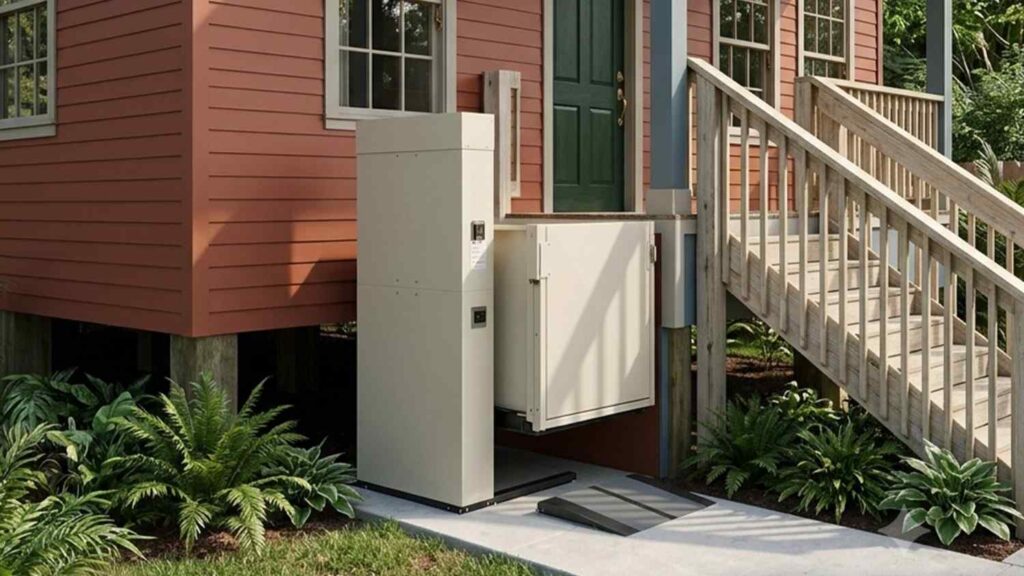
A platform lift for home — also called a vertical platform lift (VPL) or porch lift — is a motorised device that carries a person, along with any mobility aid such as a wheelchair, walker, or scooter, vertically between two levels of a building. Unlike a stair lift (which seats you in a chair that rides along the staircase rail), a platform lift provides a flat, open surface large enough for a wheelchair and its user to ride together, without transferring or disassembling any equipment.
Residential platform lifts typically travel short vertical distances — anywhere from one step up to a full storey (roughly 14 feet or 4.2 metres). They can be installed indoors, outdoors, or in semi-enclosed environments such as garages and covered porches.
QUICK DEFINITION
A platform lift is not a full home elevator. It is a purpose-built accessibility device designed for residential vertical travel — more capable than a stair lift, and more affordable than a traditional elevator.
2. Types of Platform Lifts for the Home
Not all platform lifts are built the same. Understanding the main categories helps you match the right product to your home’s layout and your personal needs.
Vertical Platform Lifts (VPLs)
The most common residential type. VPLs travel straight up and down on a vertical track, with no staircase required. They are well-suited for accessing raised porches, split-level entries, and single-floor transitions both indoors and outdoors.
Inclined Platform Lifts
These travel along the angle of an existing staircase on a wider platform that can carry a wheelchair and user together. They are a strong option when a straight-running staircase exists and the user cannot transfer to a seat. They require slightly more stairway width than a standard stair lift.
Through-Floor Platform Lifts
Designed for multi-storey access, through-floor lifts travel through a cut opening in the ceiling/floor between two levels of a home. They require more installation work but offer a clean, space-efficient solution that eliminates the need for a traditional elevator shaft.
Porch Lifts
A specific category of VPL designed for outdoor use. Porch lifts are built with weatherproofed materials and safety gates, and are commonly used to navigate the height difference between a front or rear entrance and street or garden level.
Vertical Platform Lift
Best for single-floor transitions; works indoors and outdoors.
Inclined Platform Lift
Travels along a staircase; ideal when space is tight.
Through-Floor Lift
Full-storey access without a traditional elevator shaft.
Porch Lift
Weatherproofed for outdoor use at entryways and gardens.
3. Who Needs a Platform Lift at Home?
A platform lift for home is relevant to a wider range of people than many initially expect. Common users include:
- Wheelchair and power chair userswho need to move between floors or access elevated entries without transferring out of their chair.
- Older adultsplanning to age in place who want to reduce fall risk on staircases and maintain access to all levels of their home.
- People with progressive conditions(MS, Parkinson’s, ALS) whose mobility needs may increase over time — a platform lift grows with those needs in a way a stair lift cannot.
- Post-surgery or post-injury recoverysituations where temporary mobility aids like crutches or walkers make stair use dangerous.
- Family caregiverssupporting someone who uses a mobility device, eliminating the need for manual transfers or assistance on the stairs.
- Homeowners planning aheadwho want to future-proof their home before an accessibility need becomes urgent.
It is worth emphasising that investing in a platform lift for home is not a last resort — it is increasingly understood as a proactive home improvement decision that supports long-term independence and, in many cases, adds meaningful value to the property.
4. Platform Lift vs. Stair Lift vs. Home Elevator: Which is Right for You?
These three solutions are often compared, and each has a clear ideal use case. The right answer depends on your mobility situation, home layout, and budget.
| Factor | Platform Lift | Stair Lift | Home Elevator |
|---|---|---|---|
| Wheelchair compatible | ✅ Yes — full platform space | ❌ No transfer required | ✅ Yes |
| Floors covered | 1–2 floors (up to ~14 ft) | 1 staircase at a time | Unlimited |
| Installation complexity | Moderate | Low — hours, not days | High — requires shaft |
| Typical cost (USD) | $7,500–$30,000 | $2,000–$25,000 | $20,000–$100,000+ |
| Indoor/outdoor | Both | Indoor staircase only | Indoor only |
| Home modification needed | Moderate (foundation prep) | Minimal | Major (structural) |
| Best for | Wheelchair users, aging-in-place | Ambulatory users, limited budget | Full multi-floor access, luxury |
THE BOTTOM LINE
A stair lift works well if you can sit, transfer, and stand independently — and if budget is tight. A home elevator is the gold standard for multi-floor access but requires significant structural work. A platform lift for home sits in the middle: it is the best choice for wheelchair users, for outdoor access challenges, and for anyone who wants more independence than a stair lift provides but without the commitment of a full elevator installation.
5. What Does a Platform Lift for Home Cost?
Cost is one of the most frequently searched questions around residential accessibility equipment — and for good reason. Here is a realistic breakdown.
Unit Cost
The platform lift unit itself typically ranges from $7,500 to $30,000 for residential models, depending on travel height, platform size, enclosure style, and brand. Basic short-travel outdoor porch lifts sit at the lower end; fully enclosed through-floor models with extended travel sit at the higher end.
Installation Cost
Professional installation adds $2,000 to $5,000 on average for a standard residential job. More complex installations — such as those requiring concrete foundation work, electrical upgrades, or outdoor weatherproofing — can cost more.
Accessories and Customisation
Optional features like additional safety gates, remote controls, call-and-send stations, or custom platform surfaces typically add $200 to $1,500 to the total.
Annual Maintenance
Ongoing servicing costs vary but a reasonable annual maintenance budget is $500 to $2,000, depending on whether you opt for a full service contract or pay-per-visit servicing.
Basic Porch Lift
Short travel, outdoor.
Standard VPL
Indoor or outdoor, standard features.
Enclosed / Through-Floor
Full enclosure, extended travel.
Funding and Financial Support
Many homeowners are surprised to learn that funding assistance is available. In the US, options include Medicaid waiver programs for qualifying individuals, Veterans Affairs (VA) grants for eligible veterans, state-level assistive technology programs, and some Medicare Advantage plans. In the UK, Disabled Facilities Grants (DFGs) can cover a significant portion of costs. It is always worth consulting with your local health authority, insurer, or a specialist accessibility adviser before assuming the full cost falls to you.
6. Key Safety Features to Look For in a Platform Lift for Home
Safety is the most important consideration in any accessibility product. When evaluating a platform lift for home, the following features are non-negotiable.
- Obstruction sensors— The lift should detect anything beneath the platform and stop automatically to prevent crushing injuries.
- Interlocking safety gates— Both the upper and lower access points should have gates that must be fully closed before the lift moves.
- Emergency stop controls— Clearly located, accessible controls that halt the lift immediately from the platform and from each landing.
- Non-slip platform surface— Especially critical for outdoor installations where wet weather is a factor.
- Manual lowering / descent capability— In the event of a power failure, the lift should be manually lowerable without trapping the user.
- Battery backup— The lift should continue to operate during power outages; battery backup ensures the user is never stranded mid-travel.
- Overload protection— Automatic shutdown when the platform’s rated weight limit is exceeded.
- Weatherproofing for outdoor models— Corrosion-resistant materials, weatherproof electrical components, and rated for temperature extremes.
CERTIFICATION NOTE
In the US, look for compliance with ASME A18.1 (Safety Standard for Platform Lifts and Stairway Chairlifts). In the UK, EN 81-41 certification applies. Always confirm that your installer is licensed and that the product meets the applicable local code in your state or region.
7. Platform Lift Installation: What to Expect
Installation for a residential platform lift is more involved than a stair lift but far less disruptive than a traditional home elevator. Here is a general timeline of what the process looks like.
Step 1: Site Assessment
A professional assessor visits your home to evaluate the installation area — checking available space, floor and surface conditions, power supply access, and any local permit requirements. This is also the stage where you confirm the travel height needed and discuss platform size.
Step 2: Permits and Approvals
Most jurisdictions require a building permit for a residential platform lift installation. A reputable supplier or installer will handle the permit application process on your behalf. Turn-around varies by location — expect anywhere from a few days to several weeks.
Step 3: Site Preparation
Outdoor installations typically require a concrete pad at the base of the lift. Indoor through-floor installations require cutting an aperture in the floor above. This prep work is usually completed before the lift unit itself is delivered.
Step 4: Installation
Most standard residential platform lifts can be installed in one to two days once the site is prepared and permits are in place. The installer will commission the unit, test all safety features, and walk you through operation and emergency procedures.
Step 5: Final Inspection
Depending on local requirements, a council or municipal inspector may need to sign off on the installation before the lift is cleared for use. Your installer should coordinate this.
From first contact with a supplier to a commissioned lift, allow four to eight weeks for a typical residential project — longer if permits are slow or site preparation is complex.
8. Maintenance and Long-Term Care
A well-maintained platform lift for home can last 15 to 20 years. Maintenance requirements are straightforward but should not be skipped.
Routine Tasks (User-Level)
Keep the platform and track clear of debris, leaves, and moisture. Check that safety gates close and latch properly. Test the emergency stop regularly. Wipe down exposed surfaces — especially on outdoor models — to prevent corrosion buildup.
Annual Professional Servicing
Once a year, a trained technician should inspect the drive mechanism, lubricate moving parts, test all safety sensors, check the battery backup system, and replace any worn components. An annual service contract with your supplier is the simplest way to keep this on schedule.
Signs Your Lift Needs Attention
Unusual noises, slower-than-normal travel, unexpected stops, or any error codes on the control panel are all signals to call a technician before continuing to use the lift. Do not defer maintenance on a safety-critical piece of equipment.
9. How to Choose the Right Platform Lift for Your Home
There is no single “best” product — the right choice depends on a specific combination of your home, your needs, and your budget. Use this checklist before making a decision.
- Measure your travel height accurately.The vertical distance from lower floor to upper landing determines which models are compatible and is the primary driver of price.
- Know your platform size requirement.If you use a power wheelchair, confirm its width and length, and ensure the platform can accommodate it with room to spare.
- Indoor vs. outdoor.Outdoor lifts need weatherproofing and UV-resistant finishes; indoor lifts can focus on space-efficiency and aesthetics.
- Weight capacity.Account for the user’s weight plus the weight of any mobility aid. Standard residential lifts handle 300–450 kg; confirm your requirement.
- Power supply.Most platform lifts run on a standard domestic power supply, but confirm your installation location has accessible power.
- Budget for the full project cost.Include unit, installation, permits, site preparation, accessories, and a maintenance reserve — not just the unit price.
- Choose a certified installer.Ask for proof of licensing, insurance, and experience with residential platform lift installations specifically.
- Ask about the warranty.A reputable manufacturer will offer at minimum a one-year parts and labour warranty; many offer two to five years.
PRO TIP
Request quotes from at least three suppliers and ask each one for a site visit before quoting. A supplier willing to assess your home in person will give you a more accurate price and is more likely to flag potential complications before they become expensive surprises.
10. Frequently Asked Questions
Can a platform lift for home be installed outdoors?
Yes. Many residential platform lifts are specifically designed for outdoor use. These models feature weatherproofed electrical components, corrosion-resistant materials, non-slip platforms, and safety gates that work in wet conditions. Outdoor porch lifts are among the most popular applications.
How much space does a platform lift take up?
This varies by model, but most residential VPLs have a platform footprint between 30″×48″ and 36″×60″. Through-floor models are more compact in plan but require ceiling clearance above. Your installer will confirm exact spatial requirements during a site assessment.
Do I need planning permission or a building permit?
In most jurisdictions, yes — a residential platform lift installation requires a building permit. Requirements vary by state, city, and country. A reputable installer should handle the permit process on your behalf as part of the installation package.
What happens if the power goes out while I am on the lift?
All quality platform lifts include a battery backup system that allows the lift to complete its travel to a floor level during a power outage. The lift should never leave a user stranded mid-travel. Confirm battery backup is included before purchasing.
Can a platform lift for home increase property value?
Accessibility features are increasingly valued in residential real estate, particularly in markets with ageing buyer demographics. While a platform lift may not produce a dollar-for-dollar return on sale, it makes a home accessible to a broader pool of buyers and can meaningfully support a sale rather than hinder it.
Is a platform lift suitable for a child or younger person?
Absolutely. Platform lifts are used across all age groups — from young children with physical disabilities to adults and older adults. If the user is a child, ensure the controls are either within their reach or that an attended-use mode is available.
Making the Decision
A platform lift for home is one of the most impactful accessibility investments a household can make. It preserves independence, reduces reliance on caregivers, eliminates daily risk, and allows people to stay in the homes they love — on their own terms.
The key is choosing correctly from the start: matching the lift type to your actual living situation, working with a certified installer, and understanding the full cost picture before you commit. The information in this guide gives you the foundation to do exactly that.
If you are ready to take the next step, the team at All Access is here to help you navigate your options, connect you with vetted accessibility specialists in your area, and ensure you get the right solution — not just any solution.