Vertical Platform Lift for Home: Complete Buying Guide (2026) | All Access
By All Access (All Access Health) | Home Accessibility Specialists, Philadelphia
Quick answer: A vertical platform lift is a mobility device that carries a wheelchair, scooter, or power chair straight up and down between two levels on an enclosed or partially enclosed platform. For a home, it typically costs between 8,000 and 20,000 dollars installed, takes one to three days to install in most cases, and serves as a compact wheelchair lift for home entries, porches, decks, and split levels where a ramp would take up too much space. At All Access, we evaluate the site, help you pick the right model, and handle the full installation.
If stairs, a raised porch, or a change in level at your front entry has become a daily obstacle, you have likely already looked at ramps, stair lifts, and full home elevators. A vertical platform lift sits in between those options. It gives you and your mobility device a safe, code-conscious way to move between levels without the long footprint of a ramp or the cost and construction of a residential elevator. This guide covers how a vertical platform lift works, what it costs, how it compares to other access solutions, and what to look for when choosing a wheelchair lift for home use. For a closer look at a lift in action, watch this vertical platform lift video walkthrough.
What Is a Vertical Platform Lift?
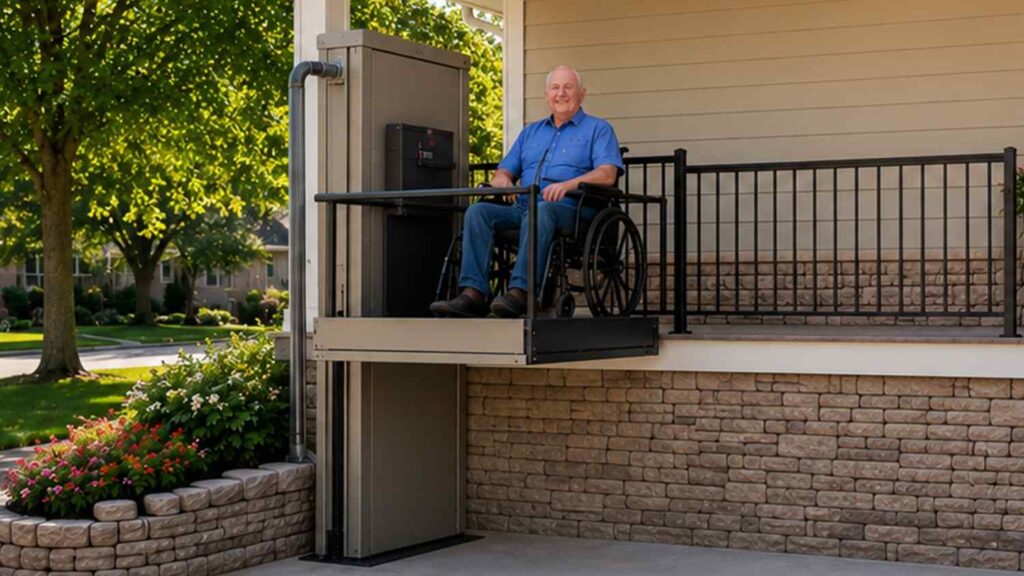
A vertical platform lift, sometimes shortened to VPL, moves a platform straight up and down along a fixed drive mast, similar in principle to a small elevator but with a much simpler structure. The user rolls a wheelchair, scooter, or power chair directly onto the platform, closes a gate, and presses a control button to travel to the next level. Unlike a stairway chair lift, a vertical platform lift carries the mobility device itself, so there is no need to transfer out of the chair.
Vertical platform lifts are built to different standards depending on whether they are for private residential use or public and commercial buildings. Both categories are commonly held to the ASME A18.1 Safety Standard for Platform Lifts and Stairway Chairlifts, which governs enclosures, controls, headroom, and structural support.
How a Vertical Platform Lift Works
Most residential vertical platform lifts share a similar set of parts:
- Platform: The load-bearing surface where the wheelchair or scooter sits, usually rated for 750 pounds or more.
- Drive mast: The vertical column that guides and powers the platform’s travel.
- Gates: A platform gate and a landing gate at the top level, both of which must be closed before the lift will operate.
- Controls: Constant-pressure buttons or a paddle switch that the user operates independently, along with a key switch or remote in many models.
- Safety systems: Emergency stop buttons, obstruction sensors, and in many models a battery backup so the lift still works during a power outage.
Depending on the model, the lift can be unenclosed, fitted inside a pre-built shaftway, fully enclosed with its own walls and roof, or built as a hybrid with a full-height cab that looks closer to a small home elevator.
Types of Vertical Platform Lifts for Home Use
Unenclosed Platform Lifts
These are the most basic and most affordable configuration: a platform and low guard rails moving along an open mast. They work well for short rises, such as getting from a driveway up to a porch, and are a popular choice when budget and footprint both matter.
Shaftway Lifts
A shaftway or hoistway lift fits inside a shaft that is either already built into the home or constructed as part of the project. This gives the lift a more finished, built-in appearance and additional weather and safety protection, at a higher cost than an unenclosed model.
Enclosed Platform Lifts
An enclosed lift comes with its own factory-built walls, doors, and roof, so no separate shaft construction is required. This is often the right balance of cost and protection for an outdoor installation exposed to weather.
Hybrid and Cab-Style Lifts
Hybrid models include a full-height cab with swing doors and finish options that resemble a small elevator, while still operating on the simpler mechanics of a platform lift. These sit at the top of the price range but blend more naturally into a home’s interior.
Indoor vs. outdoor: Outdoor vertical platform lifts generally cost more than indoor models because they need weather-resistant materials, sealed electrical components, and in many cases a cover for when the lift is not in use. If you are comparing quotes, confirm whether the unit you are pricing is rated for outdoor use.
Vertical Platform Lift vs. Wheelchair Ramp vs. Stair Lift vs. Home Elevator
| Solution | Best for | Typical footprint | Typical cost range |
|---|---|---|---|
| Wheelchair ramp | Small rises where there is room for a long, gradual slope | Large (ADA guidance suggests roughly 1 foot of ramp per inch of rise) | 1,000 to a few thousand dollars for a custom build |
| Vertical platform lift | Porches, decks, split levels, and entries with limited space | Small, roughly the size of the platform itself | 8,000 to 20,000 dollars, residential |
| Stair lift (chair) | Users who can transfer out of a wheelchair to a seat | Runs along the existing staircase | Varies by staircase length and configuration |
| Residential elevator | Multi-floor access with the highest comfort level | Requires a dedicated shaft | Significantly higher than a vertical platform lift |
A vertical platform lift is generally the most space-efficient option for wheelchair, scooter, and power chair users who need to cover a vertical distance of roughly 2 to 14 feet, and it costs considerably less than a full residential elevator.
What Does a Vertical Platform Lift for Home Cost?
Residential vertical platform lift pricing depends on the rise, the enclosure type, indoor versus outdoor use, platform size, and any custom finishes. As a general guide for 2026:
- Short-rise, unenclosed lifts (up to about 5 feet): The most affordable option, often used for porches and small entry steps.
- Mid-range enclosed or shaftway lifts: A common choice for split levels, mezzanines, and taller entries, with pricing rising alongside the height of travel.
- Tall or hybrid lifts (up to about 14 feet): The highest-priced residential option, but still typically well below the cost of a home elevator.
Across most residential projects, a vertical platform lift for home use runs from roughly 8,000 to 20,000 dollars including installation, with outdoor and multi-stop configurations at the higher end of that range. Getting a home evaluation is the most reliable way to know where your specific project will land, since local code, electrical work, and site prep all factor into the final number.
Is a Vertical Platform Lift ADA Compliant?
ADA Standards apply directly to public and commercial spaces, but they set a widely referenced safety bar that many homeowners also use when comparing residential lifts. Under the ADA Standards, a compliant platform lift must be independently operable, must allow the user to enter and exit without help, and must follow the ASME A18.1 Safety Standard for Platform Lifts and Stairway Chairlifts, which covers items such as runway enclosures, electrical wiring, structural support, and a minimum headroom clearance of 80 inches. Attendant-operated and portable lifts do not meet the ADA Standards even if they otherwise comply with ASME A18.1.
For a private residence, you are not required to meet the commercial ADA rules, but choosing a lift engineered to ASME A18.1 gives you the same safety engineering used in public buildings, which is one of the reasons it is worth asking any installer whether their vertical platform lift models meet that standard.
Choosing the Right Wheelchair Lift for Home Installation
All Access’s wheelchair lift for home page walks through current models and configurations available for Philadelphia-area homes. A few questions are worth working through before you commit to a model:
- How much vertical rise do you need to cover? Short entry steps call for a different lift than a full split-level change.
- Is the installation indoor or outdoor? This affects material choice, weatherproofing, and cost.
- What is the weight capacity you need? Most residential platforms are rated up to about 750 to 800 pounds, which covers most power chairs, but confirm your specific mobility device fits within that limit.
- Do you want an enclosed, shaftway, or hybrid cab look? This is partly a budget question and partly an aesthetic one, since some homeowners prefer a lift that blends into the home’s exterior or interior design.
- What happens during a power outage? Battery backup is a standard feature worth confirming on any model you are considering.
Installation and Maintenance
Most residential vertical platform lift installations take one to three days once a site evaluation, permitting, and any electrical or structural prep work are complete. Enclosed or shaftway models that require additional construction can take longer. Ongoing maintenance is generally straightforward: keeping the platform surface clean, testing the emergency stop and safety sensors, and having the drive system and battery checked on a regular schedule, typically once or twice a year, or as recommended by the manufacturer.
Get a vertical platform lift evaluation from All Access
All Access (All Access Health) helps Philadelphia-area homeowners choose and install the right wheelchair lift for home entries, porches, decks, and split levels. Our team evaluates your space, walks you through indoor and outdoor options, and manages the full installation.Talk to All Access
Frequently Asked Questions
What is a vertical platform lift?
A vertical platform lift is a mobility device that moves a wheelchair, scooter, or power chair straight up and down between two levels using a platform attached to a drive mast. It works as an alternative to stairs, a long ramp, or a full residential elevator, and is one of the most common forms of wheelchair lift for home use.
How much does a vertical platform lift for a home cost?
A residential vertical platform lift typically costs between about 8,000 and 20,000 dollars including equipment and installation. Short outdoor porch lifts tend to sit at the lower end, while enclosed or shaftway models with a taller rise sit at the higher end.
Is a vertical platform lift ADA compliant?
A vertical platform lift can meet ADA Standards when it follows the ASME A18.1 Safety Standard, which covers independent operation, enclosure requirements, and minimum headroom clearance. A private home is not required to meet commercial ADA rules, but a lift built to this standard offers a strong, well-tested safety benchmark.
What is the difference between a vertical platform lift and a wheelchair ramp?
A wheelchair ramp uses a sloped surface, and ADA slope guidance suggests roughly one foot of ramp for every inch of rise, which can mean a long structure for a taller change in level. A vertical platform lift moves straight up and down in a much smaller footprint, making it a practical wheelchair lift for home entries, porches, and decks where a long ramp will not fit.
How long does it take to install a vertical platform lift at home?
Most residential installations are completed in one to three days once the site evaluation, permitting, and any needed electrical or structural prep are finished. Enclosed or shaftway models requiring extra construction can take longer.